
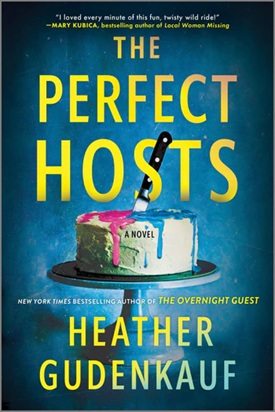
 Synopsis:
Is it a boy or a girl? They would die to know . . .
Madeline and Wes Drake have invited two hundred of their closest friends and family to their sprawling Lone Tree horse ranch near Nightjar, Wyoming (population 1200) for the most anticipated event of the year. It’s a “pistols and pearls” gender reveal party, so elaborate and sensational that it will undoubtedly grab headlines.
But the party descends into chaos when the celebratory explosive misfires. In the aftermath, one woman is dead and others, including Madeline, are injured,
The aftershocks of the bloody party-gone-wrong ripple across the small town. Senior Supervising ATF Agent Jamie Saldano arrives on the scene to investigate. But no one knows that he is battling his own demons from the time he spent there as a boy.
Saldano discovers a web of deceit spun around the Drakes. And the arrival of unexpected houseguests only deepens the mystery.
As tensions mount, it becomes clear that the explosion wasn’t just an unfortunate accident. But who was the target? And why?
The shadow of a killer looms and the parents-to-be must unravel the truth . . . before it’s too late.
Review:

Author Heather Gudenkauf says she tends to find ideas for her novels in news reports, and reading accounts of gender reveals gone wrong provided inspiration for The Perfect Hosts. Observing that gender reveal parties are supposed to be joyous, happy occasions, Gudenkauf was stunned by stories of horrific mishaps, including cases of guests being killed by flying shrapnel and fires being ignited by out-of-control pyrotechnics. She decided to devise a story in which the mishap at one such party is intentionally devised and saw it as an opportunity to examine a popular cultural phenomenon to which increasing numbers of couples aspire and/or feel obligated to stage for loved ones. In The Perfect Hosts, Gudenkauf gives readers an engrossing and entertaining story, and asks them to consider the pros and cons of the practice.
The Perfect Hosts is a departure from Gudenkauf’s Iowa-based stories. Her main character, Madeline, hails from Iowa but now lives on a large Wyoming horse ranch with her husband, Wes Drake. Part of the dramatic tension in the book springs from the fact that Madeline is residing in “a world she’s not used to. She’s out of her element,” Gudenkauf notes. Her husband and his family are the wealthiest and most powerful family in the area, and Madelin is plainly “ill at ease with” their wealth. Gudenkauf deftly imbues the narrative with a strong sense of the place through her vivid descriptions of not just the ranch and the luxurious home in which the Drakes live, but also the beauty of the vast surrounding landscape.
The Perfect Hosts opens with a bang — literally. Madeline and Wes are supposed to pull the trigger of a high-powered rifle, sending a bullet traveling at eighteen hundred miles per hour toward a vintage trucked parked nearby. Inside the truck is an explosive device that, when struck, will emit a cloud of either pink or blue powder. But when the bullet strikes the truck, it erupts into a ball of fire and from behind her, Madeline hears another loud boom. She is knocked unconscious and when she comes to, she sees wisps of pink, telling her that she is carrying a daughter. But the barn is ablaze, numerous guests are injured, and Madline’s best friend and midwife is dead. Wes’ brother vanishes without a trace. Did he survive the blast or has his body simply not been found?
The ensuing investigation is assigned to Jamie Saldano, a supervising senior agent with the federal Bureau of Alcohol, Tobacco, and Firearms based in Cheyenne. The move from Washington, D.C. to Wyoming has damaged Jamie’s relationship with his wife, Tess, who has not re-established the career she loves in the new locale. But Jamie’s skills are needed at the Lone Tree Ranch. The forensic inquiry requires a certified explosive expert.
Jamie has a conflict of interest that would most likely preclude him from filling that role if he disclosed it to the senior agent in charge. Jamie lived in Nightjar with his mother and older sister for six months, but he has not been back for twenty-seven years. Tragedy befell his family there and he is still haunted by those events. In the ensuring years, he has changed his name, but he immediately recognizes some of the residents with whom he interacted as a boy. Do they realize who he is, despite his attempt to hide his real identity and conduct a thorough investigation into how and why the gender reveal went so horribly wrong? Jamie is far and away the most complex, nuanced character in the story. She compassionately relates his heartbreaking story incrementally, making him sympathetic and moving readers to want him to find the answers he seeks, despite his questionable ethical choices.
To further complicate matters, Madeline’s estranged half-sister arrives at the ranch. She’s down on her luck, and bitter and resentful about their father’s estate. What does she really want from Madeline? How far will she go to get it?
Gudenkauf explores themes of jealousy, competition, and gossip, along with power and the way it is wielded in a place like Nightjar. Betrayals are revealed as she brings to life the people who inhabit the little town, illustrating the way they live and interact with each other, how decisions are made, secrets might be buried, depending on whose they are, and the importance of appearances and the proverbial pecking order in the microcosmic society. All of those factors play into the fast-paced mystery at the heart of the story as nearly every character falls under suspicion at some point. Madeline proves to be a woman who possesses strengths she has not previously needed to muster. But in order to protect her child, she needs an ally . . . and a plan.
Gudenkauf demonstrates that being wealthy and influential doesn’t guarantee happiness, and keeps readers guessing whodunit right up to the story’s surprising conclusion.
Excerpt from The Perfect Hosts
MADELINE
“Madeline,” comes Wes’s voice, tinny and faraway-sounding. “Are you okay?”
She is lying flat on her back, the air still hazy with smoke. Is she? Is she okay? The ringing in her ears is fading, and she can hear again. In the distance she can hear sirens. Help is coming. Madeline does a mental scan of her body. Nothing seems broken, but her head is pounding. She touches her hairline, expecting her fingers to come back with blood, but instead they find an egg- sized lump. She tries to remember exactly what happened. Wes pulled the trigger, and the truck exploded. An explosion, that’s what it was. Something had gone wrong with the reveal. The baby. Oh God, is the baby okay? She presses her palms against her belly.
“Madeline, Madeline,” comes Wes’s voice again, this time more insistent. His frantic face comes into view.
“Shhh,” Madeline orders. “Please be quiet.” She needs to lie completely still, has to concentrate so she can feel the baby move. She. The baby is a girl, Madeline thinks, remembering the wisps of pink smoke she saw among the fiery black cloud. Her little girl will kick her in the bladder, one of her favorite moves, any second now. There is nothing. No cartwheels or wiggles. Nothing.
Wes kneels beside her and slips his hand into hers. “Help is coming. Stay put. Don’t move.”
Madeline nods as hot tears roll down her cheeks. “What happened?”
“It must have been the truck,” Wes says. “It must have triggered a bigger explosion.”
“But how?” Madeline asks. “You said it was safe . . . Is anyone hurt?”
“It was. It was supposed to be.” He shakes his head, be- wildered. “I don’t know what happened.”
Madeline struggles into a sitting position and looks around. Charred lumber litters the lawn. The canopy over the dining tables has collapsed and is covered in dancing flames that a handful of guests and waitstaff are trying to smother with what- ever is handy: cowboy hats, table linens, an old horse blanket. Other guests are gathered in small, tight clusters, holding on to one another. Some sit in the grass crying, others stand slack-faced, as if in shock. Through the smoke a rodeo clown appears, his brightly colored clothing now blackened with soot and his makeup running down his sweaty face. The clown is helping the photographer, who is bleeding from the head. But it is the old storage barn that Madeline finds herself fixated on. Huge f lames shoot from the hayloft window and the roof. Someone pulls a hose from one of the horse barns, and suddenly buckets and containers of all sizes appear. Others, including Johanna’s husband, Dalton, are running toward the burning barn and tossing water onto the structure. They know that one wayward spark could ignite the house or, worse, the barns filled with her beloved horses.
“Can you walk?” Wes asks. “We have to get you away from here.”
Madeline nods, and Wes helps her to her feet. She is barefoot. The blast had lifted her in the air and knocked her flip-flops clear off her feet. Madeline, leaning against Wes, winces with each step, the rough ground pricking at the soles of her feet. He leads her to the meadow, a safe distance from the burning barn, but still close enough for her to see what’s happening. Some of Madeline’s earlier numbness is beginning to wear away, and the enormity of what has happened begins to descend.
“Go,” Madeline says, knowing they need as many hands as possible.
Wes shakes his head. “No,” he says. “I’m not leaving you.” “I’m fine,” she says, but is she? She fell hard, and still the baby hasn’t moved.
Madeline scans the crowd. “Where’s Johanna?” she asks. “Have you seen her?”
“I haven’t,” Wes says. “But I’m sure she’s around here somewhere. Have you seen Dix?”
“No,” Madeline says. The last she saw Dix was just before he handed the microphone to Wes. “Go,” Madeline repeats. “Really, I’m fine. I just have to get my bearings,” she assures him when he turns his gaze to her doubtfully. “Go help, find your brother. And check on the horses.”
“You wait here,” Wes says. “Don’t move from this spot, and I’ll come back and find you.” He squeezes her hand and kisses her cheek before darting away and disappearing into a cloud of black smoke.
Madeline continues to eye the property for any sign of Johanna’s long dark braid, her suede skirt. In the distance the wail of sirens grows closer. Help is coming. The meadow to the left of the house was being used as a makeshift parking lot for the guests’ vehicles. One wayward spark from the fire landing on the stubbled field could set off a chain reaction where upward of a hundred cars and trucks, tanks filled with gasoline and diesel, sit idly.
The air is filled with inky smoke blotting out the face of the mountain and the setting sun. A fire truck pulls through the side yard, crushing Madeline’s lavender and Russian sage, its massive tires carving deep ruts in the soil. Madeline barely notices—it’s what she sees as a group of guests part to let the truck through that causes her breath to lodge in her throat. A woman lies on the ground, her arm thrown over her face, while someone presses a blood-soaked cloth to her abdomen. One by one, Madeline registers the carnage. Someone is doing CPR on Gary Wilson, the president of the bank that holds their mortgage. One of her equestrian students is wandering aimlessly through the smoke, tears running down her face. A fifteen-hundred- pound bull has escaped the rodeo paddock and is trotting toward the mountains. She sees Mellie, the young waitress, running and screaming, fire dancing up the front of her legs. A partygoer tackles her, smothering the flames with his body.
This is bad. So very bad. Madeline fights the urge to vomit. She wants to help. But how? Water, Madeline thinks. She can pass out bottles of water, try and keep the guests calm and reassure them that help is here, that everything is going to be okay. On unsteady feet she moves toward the party barn, where she knows there is plenty of bottled water, but someone grabs her arm. Mia. “Have you seen Sully?” she asks tearfully, her arm hanging at an odd angle. “I can’t find him.”
Madeline shakes her head. “I’ll help look for him,” she promises. “You’re hurt. Sit down.”
Mia shakes her head. “I need Sully,” she says thickly and stumbles away. There are too many injured and not enough emergency personnel.
The fire truck has come to an abrupt stop. Two firefighters are urging those guests who jumped in to try to put out the fire to move away from the blaze. With machinelike efficiency, they unroll the hoses.
Madeline is mesmerized by the flames that roll across the roof of the barn, the dense cloud of smoke, the roar of lumber being eaten by the flames. She moves closer, unnoticed by the firefighters, her face growing pink from the heat. Madeline vaguely becomes aware of more sirens and shouts of “Over here” and “Please help!” More help has arrived. The spray of water hisses and snarls as it strikes flames and wood. The barn turns into a living thing then, twisting and groaning until it collapses in on itself, turning to a big heap of charred lumber with sooty farm equipment peeking out here and there.
Excerpted from The Perfect Hosts by Heather Gudenkauf. Copyright © 2025 by Heather Gudenkauf. Published by Park Row Books. All rights reserved.
Also by Heather Gudenkauf:




Comments are closed.