
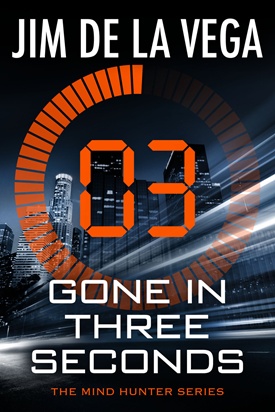
 Synopsis:
A human time bomb has three minutes. Cassidy Chord has even less.
A terrified woman bursts into a Los Angeles emergency room with a brand new tattoo. She swears she has no memory of getting it. And the numbers on her skin are somehow counting down.
00:03 . . . BOOM!
The explosion kills the woman, as well as a nurse. Hours later, a businessman in the baggage claim area at LAX detonates in exactly the same way.
Forensic psychologist Cassidy Chord, a former Blackhawk pilot, survived a blast that claimed the man she loved, as well as her leg. But nothing has prepared her to match wits with a foe intent on turning random civilians into walking weapons. The mysterious terrorist has stalked and studied Cassidy and is now engaging her in his sick game. He’s leaving her gifts, clues, and disappearing pictures and emails that turn her from an FBI consultant into a suspect.
The attacks escalate across Los Angeles. Cassidy goes rogue in her quest to find and stop the killer.
Because anyone can be next. Anywhere. Anytime. If you’re marked, you’re already gone.
Tick. Tick. Tick. BOOM!
Review:

Author Jim De La Vega has enjoyed a long career as a broadcast journalist with NBC, ABC, CBS, Fox, and CNN. In his capacity as a crime reporter, Jim has covered a wide range of stories involving school shootings and serial killers, and been threatened and shot at twice. For his efforts, he has earned the Associated Press Best Newscast award three times.
His previous novels, published under the pen name Jim Brown, include 24/7 and Black Valley, both of which have been optioned by Hollywood and published in twenty-six countries.
Now he has launched his Mind Hunter Series with three initial volumes planned, each featuring Cassidy Chord, a forensic psychologist who serves as a profiler for the FBI. The first, Gone in Three Seconds, is based on a terrifying concept. Seemingly random citizens discover freshly applied tattoos on their bodies that they have no memory of acquiring. Even more shocking is the fact that the tattoos consist of numbers arranged in what appears to be a countdown formation, followed by the word “Boom.” Worse, the numbers actually change, diminishing as the hours and minutes tick by. But how is that even possible? What kind of technology enables animated tattoos to be inked on human skin? Why won’t the ink wash off? How is the technology controlled and by whom? What does the countdown signify? And why are the particular victims selected?
As the story opens, a frightened woman proceeds to a Los Angeles-area emergency room after discovering such a tattoo on her wrist. As she pleads for help from a rookie nurse, the countdown reaches the one second mark and detonates, killing both of them. A similar scenario plays out in the Seattle-Tacoma International Airport.
Cassidy Chord is a forensic psychologist and criminal profiler, tasked with analyzing “the mind behind the crimes to predict future behavior, as well as personal traits, habits, and idiosyncrasies that would help identify the suspect.” She has been working with Lansing Psychological Services for the past two years, but that relationship is terminated due to dwindling referrals. She has bills to pay, but her own psychological trauma has interfered with her ability to serve her clients. Cassidy suffers from Post Traumatic Stress Disorder which manifests with angry outbursts and night terrors. She also experiences severe phantom limb pain, which is worsened by stress. Cassidy, a former Blackhawk pilot, decided she was ready to marry Russell and build a life with him. And she flew all the way to the Middle East to surprise him with the news. She found him on the opposite side of a busy street and began running toward him, but just as she reached him a vehicle stopped and an IED (improvised explosive devise) blew them apart. Russell died instantly and, although she survived, Cassidy’s leg had to be amputated. She now ambulates using a prosthetic leg she has christened “Steve” (because “Chris Hemsworth is too long”).
On the same night that the tattoos begin detonating, strange messages start appearing on Cassidy’s cell phone. The first says simply, “You’ve got thirty seconds.” And includes a photo of a man Cassidy has never seen before. Then it disappears. Cassidy soon realizes it was a picture of the man who bore the tattoo that exploded in the Seattle-Tacoma airport.
Cassidy calls upon an old friend, Elliott Proctor, to land a contract as a consultant to the FBI. After a brief dalliance during a period when she and Russell had broken up, she essentially ghosted Elliott, eventually reconciling with the man she fully intended to marry . Now, she needs money and desperately wants to be part of the Task Force formed to investigate the explosions. She has just spoken to Elliott when yet another disappearing message arrives: “Tell no one.”
Soon the terrorist communicates the two rules governing his maniacal activities:
- Rule number one. The tattoo is final. If you’ve got it, you’re gone. No way to stop it. No escape.
- Rule Number two. Anyone, anytime anywhere.
Cassidy, Elliott, and their fellow task force members, led by Assistant Director Gregory Taft, a man who does not suffer fools, realize they are dealing with an unknown enemy who has tools at his/her disposal about which they lack expertise. Moreover, Cassidy recognizes that the suspect is “an organized criminal” who enjoys killing and takes “great delight in the meticulous planning of each slaughter.” And they must work quickly because each successive explosion, like the tattoo(s) preceding it, is bigger and deadlier. De La Vega says he was inspired to write the tale, in part, because he has “always been obsessed with time. And as a TV news anchor and reporter, that sense of urgency only grew even stronger. The news goes live at a specific time, whether everything is ready or not.” Indeed, De La Vega’s tautly crafted narrative has a distinctly cinematic quality reminiscent of Kiefer Sutherland’s beloved television series, “24.”
De La Vega’s premise is unique and immediately evokes an emotional response from his readers. Little, if anything, is scarier than the idea of being rendered completely devoid of control over one’s own body . . . and future. As news of explosions leaks, panic sets in. The terrorist’s victims find tattoos have been placed on their bodies without their consent or knowledge, they cannot be removed, and they signify imminent death. As his/her rules make clear, no one is immune and there is no antidote or escape. The”boom ink” used in the tattoos bonds with human skin and, after it is activated, functions as an unstoppable biochemical timer. De La Vega deftly capitalizes on his clever plot device by establishing the story’s fast pace from the outset and never letting it drag. Indeed, he ramps up the tension incrementally as the number of deaths rises and his characters grow increasingly frantic to apprehend the perpetrator before he/she can claim more victims.
Cassidy is at the center of a cast of intriguing characters. She is a flawed but sympathetic warrior. She and Russell were both deployed to the Middle East, and she remains committed to serving despite her ongoing physical and psychological struggles. The nerve pain she experiences is often debilitating, described as severe cramping. Her nightmares cause her to scream in her sleep and awaken disoriented. And she is still grieving Russell, who died senselessly right in front of her. This aspect of the story is very personal to De La Vega. He explains that the book is dedicated to his younger brother, Timmy, whose “sudden death created a chasm in my heart. Cassidy’s emotional journey was also mine. She helped me work out a lot.” Cassidy is also intelligent, intuitive, and tenacious, willing to risk her life to bring the raging terrorist to justice. She becomes even more determined when De La Vega reveals the bomber’s identity and motive. Readers will take her into their hearts and cheer for her.
Cassidy is surrounded by a team of FBI agents who are equally dedicated and talented, bringing specific areas of expertise to the assignment. De La Vega portrays their relationships in an authentic, believable manner. Their banter and squabbling are plausible and entertaining, reinforcing their commitment to working together under the worst conceivable circumstances toward a common goal.
The bomber continues taunting Cassidy and the magnitude of his/her threats increases substantially the tattoos and force of the explosions seem to grow exponentially, as she and her fellow team members race to prevent more death and destruction. The relentless pursuit is engrossing, replete with shocking revelations, and highly entertaining. De La Vega also spotlights the bureaucratic wrangling that is inevitable, as well as the tension between the agency leaders who are desperate to keep the public calm as they investigate and the media representatives who want the headline-worthy, historic story.
Luckily for his readers, De La Vega promises that the upcoming second book in the series will highlight Cassidy’s skills as a profiler. He again calls upon his professional experience to bring credibility to the story which is founded upon his discussion with criminal profilers, including John Douglas, the former FBI agent who is revered for developing the FBI’s Behavioral Science Unit.
Excerpt from Gone in Three Seconds
1
LOS ANGELES — Pacific General Hospital
Please, Lord, don’t let me kill anyone tonight.
It was always the same prayer, although plea might be a better word for it, because each time she was a little more desperate, a little more . . . afraid.
Please.
Anne Thayer knew she was a good nurse—4.0 grade-point average, class valedictorian, aced her nursing boards. Friends described her as caring, outgoing, and genuinely good with people. All the things a nurse should be, right?
To Anne’s way of thinking, a hospital was more than just a warehouse for the sick. It was a place of compassion and caring, the very best aspects of being human, and as such it should be respected and maybe even a little revered.
But this? Located less than a handful of blocks from the worst section of Los Angeles County, with bars on the windows and metal detectors at the door, with people shouting and screaming and crying—this was not holy; this was hell.
Please, Lord, don’t let me kill anyone tonight.
On the first day of her new job, Anne Thayer had witnessed a thirteen-year-old boy die from a gunshot wound to the face, seen a homeless man with both legs crushed by a garbage truck, and met a twenty-two-year-old mother of three beaten so badly she would never see again out of her right eye, and yet she insisted the beating was her fault because she had held back money from her pimp.
Her pimp! Mother of three!
“Pacific General has one of the busiest emergency rooms in the country,” the charge nurse told Anne on that first day. “Time is not your friend. Treat ’em and street ’em. And whatever you do, don’t let me catch you standing around with cranium rectumitis.”
“Cranium rect . . .”
“Head up your ass.”
Car crashes, gang shootings, fires, illness, stupidity, bad luck. Anne had never realized there were so many ways for people to hurt themselves and others.
Time is not your friend. Treat ’em and street ’em.
This was not what she signed up for. What she worked so hard for.
And it bothered her that after only three weeks on the job, she understood the philosophy. There were just too many people. All pitiful in their own right. All with stories that would make you cry or cringe or sometimes both. And if you tried to care; if you tried to think of them as anything other than names on a chart, it would eat you alive.
But Anne didn’t know how not to care, which made her slow, which made everyone yell at her to go faster, which increased the chances she would make a mistake.
And a mistake here meant . . .
Please, Lord, don’t let me kill anyone tonight.
She couldn’t quit. Had to have the job. Had to. And she was a good nurse. But this wasn’t nursing. This was playing doorman at the gates of hell.
“Help me, somebody! Help meeee!” A young woman screamed.
“Anne, she’s yours,” the charge nurse yelled.
visible wounds or injuries. Patient appears ambulatory, Anne noted as she rushed the girl to an exam table. She was young, no more than nineteen or twenty, with stringy black hair and wild brown eyes and a face that might have once been pretty but was now worn and thin and distorted by fear.
Pulse racing, breathing jagged, pupils dilated. Drugs?
“What did you take?” Anne asked.
The girl, her name was Juanita Claiborne, sat on the edge of the exam table, arms crossed, ankles locked, rocking back and forth. “I ain’t taken nothin’ today. Just woke up. Found it. It won’t come off. It won’t come off!”
“What won’t come off?”
The girl was wearing a white blouse, dirty jeans and running shoes. No rings or jewelry.
“What won’t come off?”
She thrust her left arm out, palm up. It was bone-thin, with visible needle marks. Definitely drugs, Anne thought.
“There . . . there,” Juanita said, her hand trembling.
“What?” Anne saw no sign of trauma.
“The tattoo.” The words came out as a squeal.
The tattoo was half an inch up from her wrist and maybe three inches long. It was done in simple black ink. No artwork, just numbers and one scary word.
00:01 — BOOM
“It said ten hours when I woke up. It keeps changing, it keeps changing,” Juanita screamed. Her cheeks, nose, and forehead were flushed—the color of a blood blister—but the rest of her was as white as bleached bones.
“Calm down, honey,” Anne said, laying the patient back on the bed. She swabbed her arm. Then, in her calm, professional voice she said, “Well, the good news is the tattoo doesn’t look infected. In fact, it looks remarkably good, considering you got it just ten hours ago.”
“No, I didn’t get it. I woke up and it was there. And it said ten zero-zero, boom. It keeps changing. It changes every minute and now . . . oh God, oh God, oh God! It’s time, it’s time!” Her screams melted into sobs.
Anne looked down at the tattoo and saw it change from 00:01 to . . .
00:00 — BOOM
The patient, and the world as Anne Thayer knew it, exploded.


Comments are closed.