
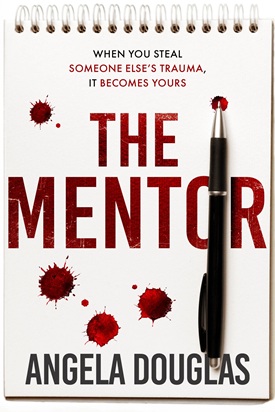
 Synopsis:
Professor Karla Dobbs has everything: literary acclaim, a bestselling novel, and a film adaptation on the horizon. That is, until a former student accuses her of plagiarism.
Natalie Silva insists that the novel in question is based on a real tragedy and insists that the release of the film must be stopped . . . or there will be grave consequences.
Confident that she has done nothing wrong, Karla dismisses her claims. At first.
As the world goes into lockdown, the truth begins to unravel, and the people behind the real story emerge, demanding answers. Threats and public scrutiny follow.
Then come the submissions from a new student.
An online mentorship program is Karla’s desperate attempt to stay afloat financially. She receives work from an anonymous writer known only as The Protégé. Each excerpt is disturbingly personal. Intimate and predictive, with chillingly precise details about Karla’s actions . . . and thoughts.
Someone is watching her.
Someone is writing to her.
As people around her begin to die, Karla realizes the most dangerous story she’s never told . . . may be her own.
And when you steal someone else’s trauma, it becomes yours.
Review:

Angela Douglas is a Canadian author based in the Okanagan. Her debut thriller, Every Fall, was recognized by the Crime Writers of Canada Excellence Awards, Canadian Book Club Awards, Pen Craft Awards, and National Indie Excellence Awards. She is a member of International Thriller Writers, Crime Writers of Canada, the Women’s Fiction Writers Association, and Sisters in Crime, and founded Eyes on Books, a Book Marketing Hub. The Mentor is her sophomore novel.
Readers who enjoy thrillers in which main characters are unreliable — and very unlikable — narrators will find much to enjoy in The Mentor.
The book opens with a harrowingly realistic Prologue depicting a parent’s worst nightmare. Readers are next introduced to Karla Pitman, an author who writes under a pseudonym, Karla Dobbs. Her last published book was a dismal failure. However, she rebounded and her subsequent novel, Unheard Cries, is another bestseller. She is again making public appearances to promote the book because it has been adapted as a major motion picture that is about to be released.
At the age of fifty-eight, Karla sees herself as a “tired” university writing professor. She has never had a solid romantic relationship or had children. She is lonely. Her father is deceased and she was forced to bring her demanding and demeaning mother, who is now in her late eighties, to live with her. Her mother can no longer live independently, and Karla cannot continue bearing the cost of having her mother reside in a facility. The two women snipe at each other and Karla is irritated that her mother insists on referring to her by the childhood nickname — Fudge — that Karla despises. Still, Karla insists that she loves her mother deeply, even though she plainly views her mother as a burden.
Adding to Karla’s misery is the fact that the draft of her next novel is well overdue. And she doesn’t simply have writer’s block. She is paralyzed, with not even a flicker of an idea for a story. Her agent is hounding her to forward him at least a few pages in order to appease her publisher, and she is depending on revenue from the upcoming film to pay her past due bills. Karla is mired in debt, including for her mother’s medical care.
As if all that isn’t enough, Natalie Silva, a former student with whom Karla has had no contact for eight years, surprises Karla by attending a promotional event and posing a question from the audience. “The trauma in this book is so visceral, it must have happened in real life. Did this happen to you? Have you lost a child, Karla?” When Karla’s long-time assistant, Tag, asks her about it, Karla feigns ignorance. But Natalie also appears at a book signing later in the day and accuses Karla of stealing a portion of the manuscript — that harrowing Prologue — she submitted in Karla’s writing class. At that time, Natalie made it clear she had no interest in publishing her purportedly fictional tale. “I trusted you with my manuscript, and you told me how brilliant I was . . . Imagine my surprise at the airport when I picked up your latest novel.” Natalie is also aware of the upcoming movie. She demands that Karla stop its release, in part because Hollywood has changed the book’s storyline significantly, including the way the lead character, a grieving mother, is portrayed.
The world shuts down due to the COVID-19 pandemic, and the movie is released directly to streaming platforms. Karla is scrambling to find a way to get out of debt. She’s drinking too much, taking Adderall provided by Tag in order to concentrate, along with nicotine gum, and barely sleeping. Her life is falling apart and matters only escalate as she becomes convinced that someone is seeking retribution. She is desperate to salvage her career and reputation — nothing ensures an author will be “canceled,” conclusively and permanently, faster than substantiated plagiarism. She is named in a lawsuit and certain that she is being followed. Is she simply paranoid?
She has taken her mentoring program online and a new student who calls themself only The Protégé begins submitting writing samples for Karla to critique. The excerpts are disjointed and somewhat rambling, so Karla requests a plot outline or synopsis in order to understand the story that seems “unhinged but interesting, a page-turner that left me wanting to know more.” Each successive submission is increasingly unnerving. The Protégé appears to know what Karla is thinking, feeling, and doing. And to predict future events. Who is The Protégé and how are they obtaining that information?
When the people closest to her begin dying, Karla is not convinced that they actually contracted COVID and succumbed quickly to the virus, as authorities insist. But medical professionals are overwhelmed, hospitals are full, and autopsies are delayed. Were they really murdered? If so, who is killing them? Can Karla find a way to make things right in time to save herself? Or will her increasingly erratic behavior ensure her undoing?
Most importantly, are any of the things Karla describes in her first-person narrative actually happening?
Douglas deftly keeps readers guessing about what is real and what Karla is only imagining in the steadily paced tale. As she searches for answers, several supporting characters emerge as potential suspects, which holds readers’ interest.
For the most part, Karla appears to be irredeemable. She is remarkably childlike, lacking decision-making skills, and her bad judgment and insupportable choices only create more chaos that she must somehow overcome. She expresses a desire to atone for the hurt she has caused several times. And dreams about paying her debts in full, selling her house, and moving into her family’s small, remote cabin, and leading a quiet life there, writing and, hopefully, reestablishing herself as a respected author and mentor. After everything that has happened, can she still make her dreams a reality? Is she sincere?
Reading The Mentor is a disorienting experience because Karla is a thoroughly unreliable reporter. She omits salient details, fails to appreciate the possible significance of developments, and it is difficult to follow her muddled thinking. All of which makes the story’s final, clever twist so shocking and satisfying. Karla is a frustrating, annoying, and, in many ways, unsympathetic character, but The Mentor is a creative and entertaining story.