
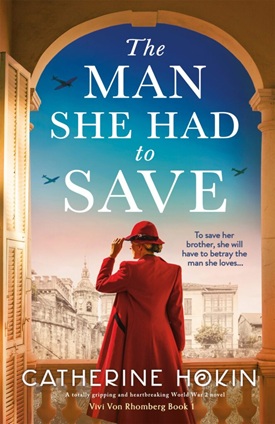
 Synopsis:
Spain, 1935. Vivi von Rhomberg arrives in Madrid and is captivated by a city which is a world away from her life as a lonely newlywed in an arranged marriage back in Berlin.
But her diplomat husband, Hannes, and beloved older brother, Christian, are In Madrid for one reason only: to bring the Nazi regime to Spain. And they are willing to destroy everyone and everything that stands in their way.
Eventually, Vivi’s worlds collide. Christian is taken captive by Emilio and his fellow Loyalist fighters. Vivi and Emilio are in love and planning a future together after World War II finally ends. Vivi faces an impossible choice.
And whichever side she chooses, there will be consequences . . .
Author Catherine Hokin has penned another sweeping historical story of love and betrayal, this time set against the backdrop of the Spanish Civil War and World War II.
Review:

Author Catherine Hokin says she has been “fascinated with the Spanish Civil War for a very long time, although it took me an equally long time to understand it.” She initially thought “the conflict was a very romantic thing.” And it sounds shocking today, but she relates that in school she was taught that Francisco Franco Bahamonde, the Spanish military general who rose to power in 1939 and ruled the country until his 1975 death at the age of eighty-two, was a “benevolent dictator.” Hokin eventually learned that war “is never romantic and Franco was a tyrant who built his regime on brutality, repression, and fear.” He was also an ally of Adolph Hitler, as Hokin discovered when she was researching the “ratlines” used by Nazis in Spain to escape back to Germany in 1945.
Hokin also found that today Berlin and Madrid are cities that address their notorious histories in vastly diverse ways. Throughout Berlin there is evidence of the city’s past, but that is not the case in Madrid. “Franco wiped away everything about the war except his triumphs, and you won’t find its places or people recorded in plaques or buildings or museums there.” Nonetheless, she was able to conduct sufficient research to write another riveting, emotionally moving, and thought-provoking story that fans of historical fiction will embrace and devour, The Man She Had to Save. Happily, it is the first installment in her new Vivi von Rhomberg series. And at the end of the book, she leaves readers clamoring for more of Vivi’s compelling story.
For Hokin, The Man She Had to Save reflects Spain during the period of 1935 to 1945. The tale is full of “secrets and lies,” just as “essentially state-mandated forgetting” buried so many facts about that time, many of which will forever be lost and never revealed.
The book opens with a prologue that immediately pulls readers into and invests them in Hokin’s beautifully crafted story. It is March 1945 in the Spanish Pyrenees and Vivi’s first-person narrative establishes the story’s dramatic tension: “My brother is facing a firing squad, and the man I love gave the order to kill him.” She elaborates a bit: “Whoever I choose, the other will hate me. Whoever I choose, there’s no escaping that fate.”
The action then moves back to Berlin in August 1934 and Hokin begins revealing who Vivi von Rhomberg is and how, eleven years later, she finds herself trapped in an impossible-to-imagine moral quagmire.
Vivi and her brother, Christian, five years her senior, are the children of Leopold, a legendary German pilot who flew combat missions during World War I. Christian was trained by his father from an early age to follow in his footsteps and there is nowhere he would rather be than in a cockpit. Leopold also embraced the National Sociality Party from its inception, as well as its leader, Hitler, taking Christian with him to meetings and indoctrinating him. Leopold is part of the Aviation Ministry which is gearing up to seek revenge for Germany’s humiliating defeat and the terms of the Treaty of Versailles.
Their mother, Caterina, wiped away all traces of her Spanish origins when her mother, Elena, died. Leopold had always ignored Vivi, for the most part, but in her grief, Caterina too became cold and distant. As seven-year-old Vivi mourned her beloved abuelita, it was Christian who comforted her, telling her, “You’ll never be on your own, Vivi, not as long as you’ve got me. I’ll always look out for you; I’ll always be there.” Since then, Christian has been her hero and protector.
At the age of just twenty-one, Vivi is to be married to Hannes in a ceremony atteünded by the highest-ranking members of the Nazi party at which “the Führer would be the focal point of the day, not the bride.” Hannes and his family are as devoted to Hitler and his vision for Germany as Leopold and Christian. It is an arranged marriage – Hannes is practically a stranger, but Vivi naively believes that she can be happy because they will learn to love each other. A horrifying event mars the wedding day and provides Vivi with a shocking glimpse into what exactly her father, brother, and new husband believe.
When Hannes is posted as the attaché at the German Embassy in Madrid – an assignment Vivi suspects Christian secured for him – she is hopeful that a new city might represent a fresh start for her floundering marriage.
By 1936, a military coup has been launched by a group of Spanish generals and Vivi is a witness to the turmoil and the suffering of Spain’s citizens. It becomes increasingly dangerous for Vivi to move about Madrid since she is a German diplomat’s wife. And her feelings about the revolution, as well as what is happening back in Germany, cement. She clashes with Christian, who insists that Germany is once again “a power on the world stage” because of the wonderful things Hitler is doing and that Franco will “repeat the same miracle for Spain.” Vivi is expected to host parties and receptions for Franco and his fellow generals, but Vivi is repulsed.
Soon the bombing raids begin . . . and the kindness of a stranger who pulls Vivi to safety in a cellar changes her life. Emilio is a member of the Loyalist militia fighting the Nationalists. He explains that he comes from a working-class family and “I owe everything I am to the Republic” that gave him an education and opportunities. He tells her he is standing up for Spaniards who were “finally given the hope of a voice . . . [E]veryone Franco would silence and crush.”
The Man She Had to Save is a coming-of-age story. Hokin credibly details Vivi’s transformation from a sheltered, innocent young woman with no power to form her own opinions and have autonomy over her own life into a woman who trusts her understanding of right and wrong, moral and immoral, and refuses to passively go along with her family’s expectations and demands of her. Rather, she gradually realizes that she must risk her own safety in order to fight injustice and inhumanity. When suspicion begins swirling around her, she will neither be dissuaded nor attempt to focus attention on anyone else in order to save herself. She also learns that real love is selfless and sometimes requires sacrifices that are neither fair nor just. Her relationship with Emilio is fraught with danger not merely because she is a married woman. As the wife of a German diplomat, she is recognizable and vulnerable should she be caught with Emilio. Seeing Vivi discover, grow into, and finally claim her own power is captivating.
Hokin believably demonstrates how differing ideologies destroy relationships, tearing families apart. Vivi is increasingly horrified by her husband’s and brother’s devotion to the Third Reich as Hitler’s power grows and he invades other countries such as France and expands the war into Russia. Readers are dialed in to Christan’s involvement in the war, but Vivi is not privy to the full scope of his efforts. She suspects that he is perpetrating unspeakable atrocities because of rumors, descriptions, sightings, and her partial knowledge of his whereabouts at specific times. She is terrified that the stories may be true, but she knows her brother’s heart so well. When she confronts him, he is aghast that she could even consider for a moment he might be capable of such heinous acts. He insists that while he fully supports Hitler’s agenda and alliance with Franco, there are limits to what he is willing to do in service to the Führer. He is sincere and utterly convincing. How can Vivi not believe the big brother who has always loved her unconditionally and promised to always look out for her? Her emotional struggle over whether to rely upon her instinctual belief in her brother’s goodness, trust that he has been completely forthright with her, and fight for his exoneration is heartbreaking, wrenching, and plausible. Choices that Vivi makes in her relationship with Emilio further complicate matters and, of course, add to her consternation. It all makes for an engrossing story that is both painful to read and impossible to stop reading . . . until the whole truth is finally revealed and Vivi must contend with the consequences.
In that respect, The Man She Had to Save is a contemporary story, published at a time when the United States is more divided along ideological, moral, and ethical lines that it has been since the Civil War. Readers will perhaps see in Hokin’s drama some of the conflicts they have experienced in their own families and with friends. The book is an excellent selection for book clubs because its themes can inspire discussion and debate.
When they first meet, Emilio tells Vivi that “whoever wins, it won’t be Spain. Whoever wins, we all lose.” In The Man She Had to Save, Hokin demonstrates the truth of that statement through the challenges her characters, especially Vivi and Emilio, face. Because war is, of course, never the answer, a lesson that throughout history has been taught repeatedly, but never fully heeded. The Man She Had to Save concludes just as World War II is ending and it will be fascinating to see where Vivi’s story picks up in the next installment of this remarkable new series.




1 Comment
Thank you so much for being on the tour and for connecting so deeply with the book x