
 Synopsis:
Furniture artisan Meli Hynes abides by her uncle’s truism. “If there was ever a great love story, it’s between an artist and their creation, and nothing else. Best you remember that.”
Meli gave marriage a shot — for all of twenty-four hours during a Las Vegas fling — and then made her choice. The wood-crafting shop that is her family legacy will always come first.
But when her uncle decides to sell the shop to a competitor and Meli’s promised inheritance goes belly-up, she’ll do anything to muddle the deal. That includes a marriage of convenience to an unforgettable and very practical old friend — the competitor’s son, Aaron, who has his own controlling family. He’s every bit as impulsive as Meli. So Aaron is in. After all, it isn’t the first time he and Meli got married on just a whim.
The rules of the ruse are simple: public displays of affection and living together as happy newlyweds.
The hardest rule of all? Never let real feelings get in the way of what they plot as a purely professional second time around.
In Falling for You Again, fate reunites a young woman with her ex-husband in a story about family, old loves, second chances . . . and marriage on a dare.
Review:

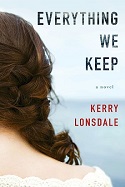
Kerry Lonsdale is the bestselling author of the popular “Everything” series (Everything We Keep, Everything We Leave Behind, and Everything We Give) and the “No More” trilogy (No More Words, No More Lies, and No More Secrets), as well as four previous stand-alone novels: All the Breaking Waves, Last Summer , Side Trip, and Find Me in California.
It’s always interesting to hear where fiction writers find inspiration for the stories they create. Lonsdale says that sometimes “an entire story will just drop into my head.” That happened with Side Trip — the whole tale simply materialized. But usually the story “starts with just a concept and it evolves from there.” She describes herself as a “plotter,” meaning she outlines the entire story so she knows the trajectory before she begins writing, even though she may make changes as the manuscript comes together. “I at least need somewhat of a dirt road to follow, but a lot of times the characters will take over the story.”
In the case of her latest book, Falling for You Again, Lonsdale envisioned a runaway bride ditching her wedding, in a taxi on her way to the airport. She wondered why she was running, where she was going, and what would happen when she boarded a plane. The story evolved from there.
Twenty-nine-year-old Meli Hynes has grown up in the furniture manufacturing business. . Her family is unusual – and highly dysfunctional. Her parents mysteriously went away when she was just ten years old and did not return until she was sixteen. Her Uncle Bear became her legal guardian and, since he operates Artisant Designs in South Boston, a high-end wood furniture studio he inherited from his father, she learned the trade, as well. She and her parents work there – “the studio is the only place where, other than Uncle Bear’s apartment to celebrate holidays and birthdays, my family willingly spends time together.” Meli explains that the business has strained their marriage and she is amazed her parents have stayed together. Her best friend, Emi, lives in an apartment directly across the hall from hers and her parents live in the same building on an upper floor. But outside observers watching them meet in the elevator would believe they are merely tenants in the same building, rather than family. They are not close and Meli still bears the deep wounds of abandonment and feeling unwanted. Years later, she still has no idea why they left her in the care of her uncle or where they spent those six years. All she knows is that when they came back, they were different. “They’re friendly toward me now, but never loving. They’re more reserved than open, more guarded than trusting.”
Meli accidentally finds an email to Uncle Bear from The Savant House, an upscale home-furnishings company, the subject of which is “Potential Acquisition of Artisant Designs.” Meli is shocked and hurt because her uncle has always promised her that she will inherit the business. Worse, she learns that Savant will acquire not just the studio, but all designs, including hers which are copyrighted under Artisant. Without her knowledge or input, arrangements have also been made for Meli to have a job at Savant overseeing a team of artisans and designing a furniture line. But Meli has never had any interest in working for a large corporation. For the past nineteen years, her dream has been to carry on the family business, but her uncle’s mind is made up because of the increasing challenges of operating a small business. He wants to retire.
Also on the desk where she spies the email is an invitation to Savant’s annual fund-raising gala, an event to which her family is always invited, but they never attend. Meli decides she will be there because she needs to reconnect with Aaron Borland, Savant’s Director of Acquisitions. Meli met him five years ago on a flight to Las Vegas. And married him. Six days later, they parted company back at Logan International airport, got a divorce, and haven’t seen each other since.
Lonsdale’s choice to tell Meli’s story via her first-person narrative makes it emotionally powerful because readers accompany Meli on her quest to make her own way in the furniture world and create a personal life that will bring her happiness, and are privy to her thought-processes and emotions. She explains how she unexpectedly became a runaway bride with Uncle Bear’s blessing. It wasn’t until she watched Emi walking up the aisle of the church that she recognized she had been in denial about her relationship with her fiancée. She realized that “finding Paul hadn’t helped me find myself; it had made me feel more lost.” He was charming, but she was naïve. She craved love and he was the first man “who wanted me all to himself.” But that was the problem. While Paul initially admired her devotion to her work, he came to see it as a “competition for my attention” and actually had the audacity to ask Meli to give up woodworking. Mali knew – as she was standing in the vestibule of the church – that she simply could not walk down the aisle and marry Paul.
So, with Uncle Bear’s support and encouragement, she ran. In her wedding dress. She booked herself on the first available flight to Las Vegas. And found herself sitting next to Aaron.
Lonsdale effortlessly navigates the story between the present day, as Mali arrives at the gala in search of Aaron, desperate to find a way to stop the sale of Artisant, and five years earlier as Meli and Aaron chat easily on the flight. Aaron is obviously intrigued by the beautiful young woman in the wedding dress, and amused and charmed by her chutzpah. Because, after all, boarding a plane in full wedding regalia is not something one does routinely. And before the plane lands, they have agreed to marry for one full day.
Lonsdale considers herself a “domestic drama” author, even though every one of her books incorporates romance. In Falling for Your Again, the romance between Meli and Aaron is front and center, the focus of the story. But Lonsdale remains true to her strengths as a writer. She has again crafted fully developed, multi-layered characters who are intelligent and accomplished, and extremely likable. Both Meli and Aaron are charming, so readers will easily take them into their hearts and want the best for them.
But they also deal with serious issues that make them empathetic and relatable. For Meli, as noted, abandonment by and emotional detachment from her parents, in combination with Uncle Bear urging her to eschew intimate relationships in favor of fully devoting herself to her creative passion, have been overarching themes in her life. Lonsdale credibly details how Meli has functioned fairly well, but as the story opens and she discovers that her future is in jeopardy, she is forced to make critical decisions about her future. Should she attempt to stop Uncle Bear from finalizing the sale of Artisant? And accept the offer of a secure position with Savant, a powerful and influential force in the industry where she can advance in her career?
She also finds herself at a personal crossroads because she believes her only hope of stopping the sale is to procure Aaron’s assistance and, although they divorced and have had no contact for five years, Meli certainly never forgot about him. And has not fallen in love with any other man in the interim. She has been singularly focused on her work and attempting to co-exist with her family. But inside she remains a “lonely little girl” who wants “connection more than anything else.” And it may just be time for her to admit that she wants that more than she wants to retain Artisant Designs. She has missed Aaron, even though she barely got to know him, and wonders if he has missed her. And if he has ever regretted their no-contact vow. She is perplexed by his failure to break it and reach out to her in light of Savant’s pending acquisition of Artisant Designs. What does that signify about how he feels about her?
Aaron is an equally compelling character with his own family issues to work through. At only thirty-two, he has been promoted from Director of Acquisitions to Chief Operations Officer, with his father serving as CEO and his mother is the President of Savant. Aaron has recently broken off his engagement to the woman his mother wants him to marry. He has always lived a privileged life, but that not mean life has always been easy for him. His parents have expected him to work hard, learn what it takes to operate a successful business, and earn his place in the organization. He is bright and savvy. And since he is aware that Savant maintains a no-fraternization policy, Aaron postulates that if he and Meli marry (again), Savant will retract its offer to acquire Artisant Designs due to the conflict of interest their marriage would create. “Maybe ‘our thing’ is to do the outrageous,” Mali thinks as she considers the possibility of a marriage of convenience designed to save the future she has always envisioned for herself. But they would have to pretend to be a happy couple in a completely legitimate, genuine marriage. The idea is not without risks, including potential legal complications and the ire of Aaron’s family. And he has his own complicated relationship with his parents, in part because of his guilt surrounding a family tragedy, as well as their expectations.
Along the way, Lonsdale injects surprising twists that call into question the wisdom both of Meli and Aaron’s scheme and their reunion. As they consider whether they are right for each other and should, perhaps, remain married this time, external developments and a few within their relationship come to light, throwing their anticipated happy ending into doubt.
Falling for You Again is a delightfully entertaining story, full of humor, charm, and hope. But Lonsdale imbues what is essentially a light-hearted romance with depth, emotional resonance, and complications. In this instance, Lonsdale explores the parent-child relationships of her two main characters with compassion, nuance, and revelations that provide context and understanding. She also examines the struggle to balance one’s personal and professional pursuits and priorities, and the ongoing challenge of doing justice to both. There is also a message in her story about being a woman who is passionate about her work and need to express herself creatively, and the difficulties encountered while attempting to establish a true partnership in which both parties are equals who appreciate and value each other.
It is not a spoiler to reveal that Lonsdale delivers the de rigueur happy ending – it is a romance, after all – but she navigates the story in a masterful and often unexpected manner to that logical and very satisfying conclusion.
Also by Kerry Lonsdale:
Standalone Novels




The Everything Series


The No More Series





Comments are closed.